AI Strategy Consultant: What They Do and What They Cost
What Does an AI Strategy Consultant Do, and Is One Worth It?
An AI strategy consultant helps a business decide where artificial intelligence (AI) can solve real problems, which opportunities to prioritize, and how to implement them responsibly. They can assess your readiness, recommend suitable tools, estimate costs, and build a practical roadmap. Whether hiring one is worth it depends on your goals, risks, budget, and in-house expertise.
What does an AI strategy consultant do?
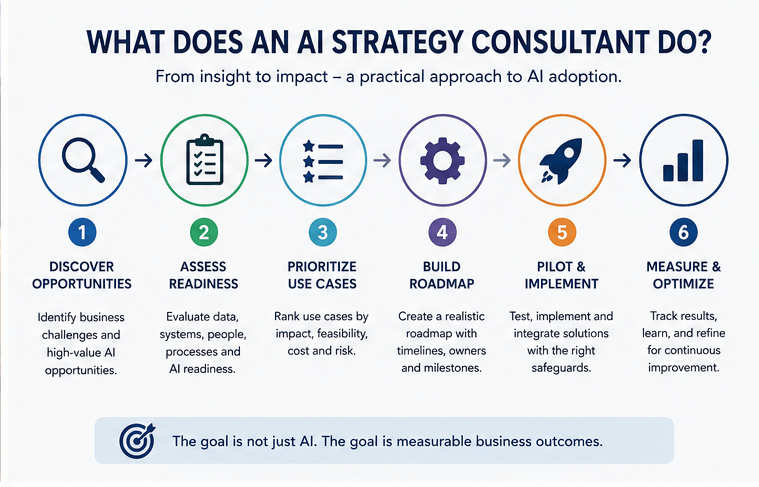
An AI strategy consultant connects business goals with practical uses of AI. Rather than recommending technology simply because it is popular, they help you identify where it could create measurable value—and where it might not be worth the investment.
Their work may include:
Finding opportunities: Identifying repetitive tasks, bottlenecks, and customer problems that AI could help address.
Assessing readiness: Reviewing your data, software, processes, skills, and security requirements.
Prioritizing projects: Comparing potential use cases by business value, cost, complexity, and risk.
Choosing tools: Evaluating existing software, AI assistants, workflow automation platforms, and custom solutions.
Creating a roadmap: Setting out what to do first, who is responsible, what it may cost, and how success will be measured.
Supporting implementation: Helping a team test a solution, train employees, establish safeguards, and review results.
The exact scope varies. Some consultants focus on business planning and recommendations; others also build and integrate AI systems. Confirm which services are included before signing an agreement.
For example, a small service business might want to respond to enquiries faster. A consultant could map its current enquiry process, assess whether its existing customer relationship management (CRM) software can automate follow-ups, and recommend a small pilot before suggesting a more complex AI system.
The goal is not to add AI everywhere. It is to choose the right solution for a specific business need.
What deliverables should you expect from an AI consultant?
You should receive useful work products—not just a presentation about the potential of AI. Deliverables depend on the engagement, but a clearly scoped project may include the following.
Deliverable
Discovery findings
AI readiness assessment
Prioritized use cases
Cost and value estimates
AI roadmap
Risk and governance guidance
Pilot plan
What it should contain
Business goals, current challenges, and existing processes
Data, systems, skills, security, and operational gaps
Opportunities ranked by likely value, effort, and risk
Expected costs, assumptions, success measures, and uncertainties
Recommended sequence, owners, milestones, and next steps
Data handling, human oversight, testing, and accountability
Scope, timeline, success criteria, and conditions for continuing or stopping
Ask whether the consultant will provide editable documents, a prioritized action plan, and a handover session. Also clarify whether implementation, software subscriptions, employee training, and ongoing support are included in the quoted fee.
A strategy document is only useful if your team can act on it. Recommendations should be specific enough to guide a real decision.
What is an AI readiness assessment?
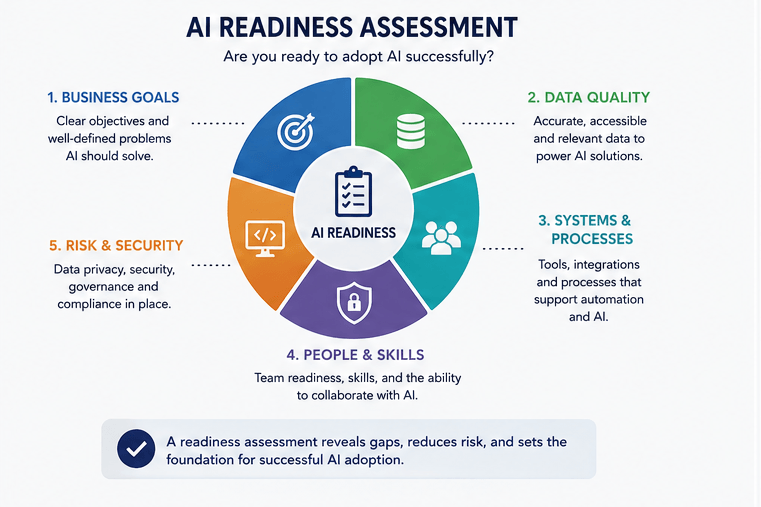
An AI readiness assessment evaluates whether your business has the people, processes, data, and technology needed to adopt AI successfully. It also helps identify what should be fixed before investing in a solution.
A useful assessment considers five areas:
Business goals: Is there a clearly defined problem to solve, such as slow lead response, high administrative workload, or inconsistent customer service?
Data quality: Is the information needed for the task accurate, accessible, organized, and appropriate to use?
Systems and processes: Can your existing software support the proposed solution? Are your workflows documented and reasonably consistent?
People and skills: Does someone own the process? Can employees learn the new workflow and recognize when AI output needs checking?
Risk and security: How will you protect confidential information, control access, verify outputs, and handle errors?
Risk assessment matters because AI systems can produce inaccurate or unsuitable results. The US National Institute of Standards and Technology provides a voluntary AI Risk Management Framework that organizations can use to help manage AI-related risks. It is a useful reference, not a requirement that every small business must adopt in full.
An assessment should end with clear recommendations. Your business might be ready to test an AI tool, need to clean up its data first, or discover that ordinary automation is sufficient.
Readiness does not mean buying the most advanced technology. It means understanding what your business can support today and what needs to change.
How much does an AI consultant cost?
There is no single standard price for an AI consultant. Fees vary according to the consultant's experience, location, project scope, technical complexity, and whether implementation is included.
Published pricing guides provide different estimates rather than a definitive market rate. For example, a 2026 guide from Tavoko lists US$2,000–US$10,000 for an AI readiness or opportunity audit and US$5,000–US$25,000 for a strategy roadmap for the small and medium-sized business segment it defines. These are indicative figures from a commercial provider's guide, not an independent industry-wide benchmark. See its AI consulting cost guide, updated July 2026.
Common pricing models include:
Hourly or daily consulting: Useful for a short advisory session, expert review, or clearly limited piece of work. Costs can be harder to predict if the scope expands.
Fixed-fee project: An agreed price for defined deliverables, such as a readiness assessment or strategy roadmap. This can make budgeting easier when the requirements are clear.
Monthly retainer: Ongoing access to advice, implementation planning, or strategic support. It suits businesses that need continuing guidance rather than a one-off recommendation.
Implementation project: A separate fee for building integrations, configuring tools, developing custom applications, testing, and training staff.
For a small business, the sensible starting point is often a tightly scoped assessment or strategy project rather than a large transformation programme.
Before comparing quotes, check what each price covers. Ask whether software subscriptions, API usage, data preparation, security reviews, training, maintenance, taxes, and third-party services are additional. A lower consulting fee may not represent a lower total cost.
Treat any quoted price as incomplete until you understand the full cost of owning and maintaining the solution.
How can you tell whether AI consulting is worth the investment?
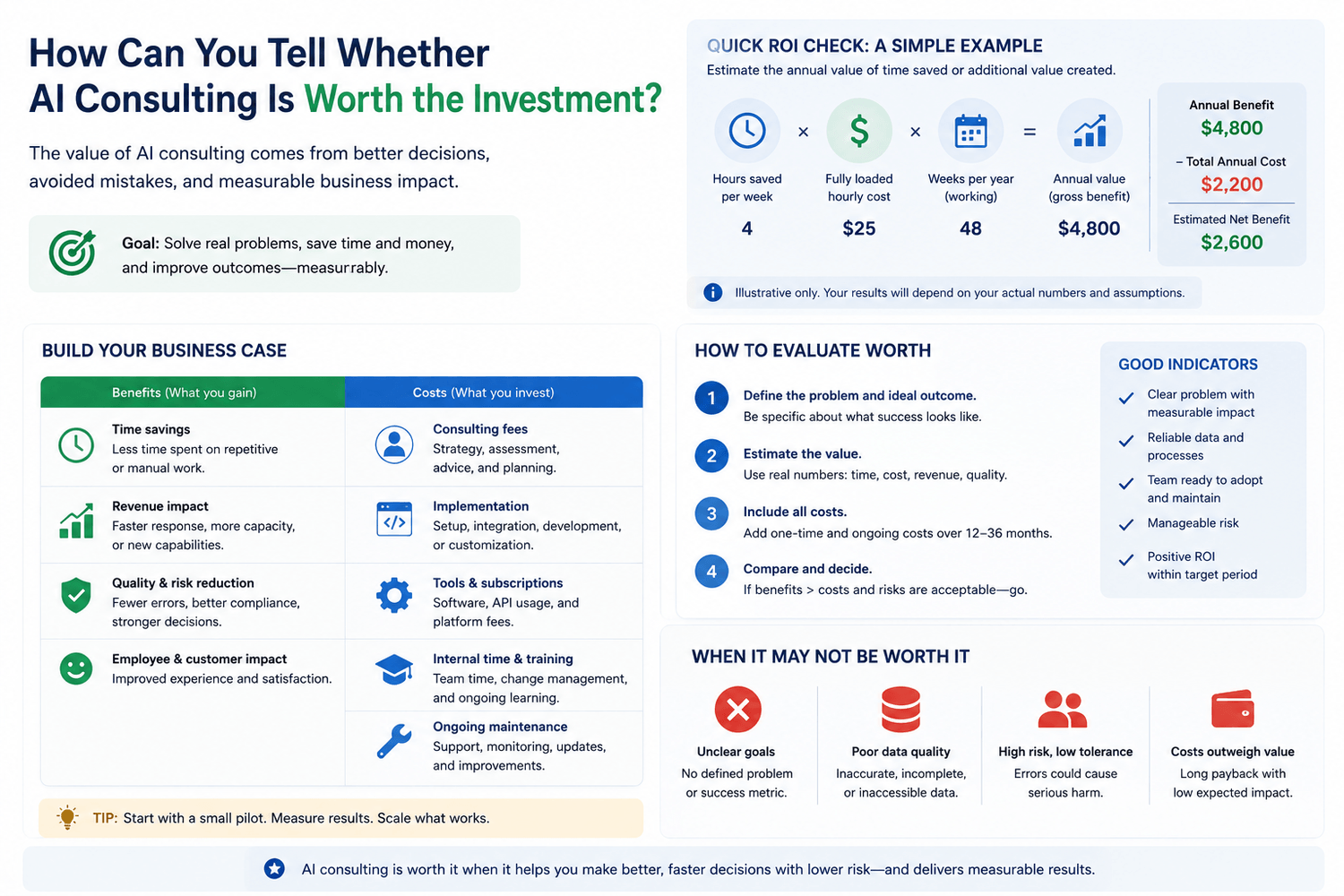
AI consulting is worth considering when it helps you avoid a costly mistake, prioritize a valuable opportunity, or move forward with more confidence. The value should be assessed against a realistic alternative—not against a promise that AI will automatically increase revenue.
Consider this simple example.
A business spends 10 hours each week on a repetitive administrative process. If a proposed solution could safely save four hours weekly, the business could estimate the value of that time using its actual labour cost or the value of the work employees could do instead.
To assess the business case, include:
The consultant's fee.
Software, setup, and integration costs.
Staff time spent testing, learning, and maintaining the system.
The value of time saved or errors reduced.
Any effects on service quality, customer experience, or revenue.
Illustrative calculation—not a promised result: If a workflow saves four hours a week, and the business values that time at US$25 per hour, the gross value of the time saved is approximately US$433 per month, using 4.33 weeks per month. That is before software, consulting, maintenance, and other costs. It also assumes the saved time can be put to productive use.
This calculation helps frame the decision; it does not prove that a particular AI project will pay for itself. A pilot should test whether the time savings actually occur and whether the output remains accurate and useful.
The OECD's 2026 survey on SMEs and AI, published on 13 April 2026, discusses small and medium-sized businesses' use of AI. It identifies barriers including time constraints, maintenance costs, skills gaps, and cybersecurity challenges. These are practical reasons to plan adoption carefully rather than treating AI as a guaranteed shortcut.
Do you need an AI consultant for a small business?
Not necessarily. Many small businesses can begin using familiar AI features or straightforward workflow automation without hiring a consultant.
You may not need one if:
You have one clearly defined, low-risk task to improve.
Your current software already includes a suitable feature.
You can test the tool safely with non-sensitive information.
Someone on your team can evaluate the results and maintain the workflow.
The cost and complexity of consulting would exceed the likely benefit.
For example, a business owner may be able to use an existing writing assistant to draft routine marketing copy, with a person checking every draft before publication. A standard form-to-spreadsheet workflow may also be handled by an ordinary automation tool rather than a custom AI system.
However, consider expert help if several departments need to coordinate, sensitive data is involved, existing systems must be integrated, or an incorrect output could have serious consequences. A consultant may also be useful when leadership has many competing AI ideas but no agreed way to prioritize them.
Start with the smallest sensible step. If you can identify the problem, test a solution, and measure its value internally, you may be able to proceed without a consultant. If you cannot, an independent assessment can help clarify the decision.
How should you choose an AI strategy consultant?
Use a structured process to compare potential consultants before committing to a large project.
Define the business problem. Describe the current process, who it affects, and what you want to improve.
Ask about similar work. Request relevant examples and references, with permission to contact clients where appropriate.
Check the proposed deliverables. Look for a clear scope, practical recommendations, assumptions, and measurable success criteria.
Understand the full cost. Ask what is included, what is billed separately, and how scope changes are handled.
Agree on safeguards and ownership. Clarify data access, confidentiality, human review, documentation, system ownership, and ongoing support.
Start with a limited engagement. Where possible, test one use case before committing to a wider rollout.
Be cautious of guarantees of specific financial returns without evidence, recommendations that ignore your existing tools, or proposals that push a complex custom system before establishing the business case.
A good consultant should be willing to explain the limitations of AI, identify situations where it is unnecessary, and help you make an informed decision—even when that decision is to wait.
What should a practical AI strategy look like?
A useful AI strategy is a short, prioritized plan that connects business goals to specific actions. It should identify the first use case, explain why it matters, state what the business needs to implement it, and define how the result will be measured.
For a small business, that might mean testing an AI-assisted process for classifying incoming enquiries, with a person reviewing the result before any customer response is sent. The plan should specify how accuracy will be checked, what information the tool may access, who handles exceptions, and what performance would justify expanding the pilot.
Avoid beginning with a long list of tools or an ambitious transformation programme. Start with a real operational problem, establish a baseline, run a controlled test, and review the results.
How can Unboxed Automation help?
If your business is exploring AI or workflow automation, the next step is to clarify the problem you want to solve and the outcome you need. Review your current process, identify where time or accuracy is being lost, and decide whether a simple tool, an automation workflow, or specialist guidance is the most appropriate response.
Editorial note: Confirm Unboxed Automation's actual services, preferred positioning, and approved call to action before publishing this section. Do not imply that the company offers a formal AI strategy consultancy or readiness assessment unless that has been verified.
Frequently asked questions
What is the difference between an AI consultant and an AI developer?
An AI consultant typically focuses on business needs, opportunity selection, planning, and recommendations. An AI developer builds or integrates the technical solution. Some professionals do both, so confirm the responsibilities and deliverables in the proposed engagement.
How much does an AI consultant cost for a small business?
Costs depend on scope, location, and the type of work. One commercial pricing guide published in 2026 lists US$2,000–US$10,000 for a readiness or opportunity audit and US$5,000–US$25,000 for a strategy roadmap for its defined small and medium-sized business segment. These are indicative published estimates, not guaranteed quotes or universal rates.
What should an AI readiness assessment include?
It should review business goals, data quality, existing software, processes, staff skills, security, and risks. The outcome should be a prioritized set of recommendations explaining what to do first, what gaps need attention, and how to evaluate success.
Can a small business use AI without hiring a consultant?
Yes. A business can start with built-in AI features or low-risk tools when the problem is clear, the information used is appropriate, and someone can check the results. Specialist advice becomes more valuable when the work is complex, sensitive, expensive, or difficult to evaluate.
How long does it take to develop an AI strategy?
It depends on the business's size, the number of systems involved, data readiness, and the scope of the assessment. A narrowly defined review may take much less time than a multi-department strategy. Ask for a timeline tied to specific deliverables rather than relying on a generic estimate.
Sources
OECD — Empowering SMEs in the Age of AI: The 2026 OECD D4SME Survey. Published 13 April 2026. Useful for context on SME adoption, skills gaps, maintenance costs, and cybersecurity challenges.
https://www.oecd.org/en/publications/empowering-smes-in-the-age-of-ai_bf5a9816-en.htmlNational Institute of Standards and Technology (NIST) — AI Risk Management Framework. Official guidance for understanding and managing AI risks; the framework is voluntary.
https://www.nist.gov/itl/ai-risk-management-frameworkTavoko — AI Consulting Cost Guide. Commercial pricing guide updated July 2026. Used only for indicative examples of published assessment and strategy fees; figures are not an independent industry benchmark.
https://www.tavoko.com/guides/ai-consulting-cost
Author bio — requires approval
Draft placeholder: Rob Robertson works with [approved description of relevant role and experience]. His work focuses on [verified areas of expertise relevant to the article]. Connect with [approved company or professional link].
Do not publish this placeholder as a final bio. Ask Rob to confirm his preferred biography, credentials, relevant experience, and link.
Client example — approval required before publication
Action for @Rob Robertson: Please provide one approved Unboxed Automation client example, including:
The client's business context and original problem.
The process or workflow that was improved or automated.
The solution delivered and the client's role in implementation.
The verified outcome, including the measurement period and supporting evidence where available.
Written permission to publish the example and identify the client, or confirmation that it must be anonymized.
If no approved example is available, do not invent one. Either omit this section or publish only after the editorial owner explicitly approves an alternative that meets the brief.
Prepublication checklist
Confirm Unboxed Automation's services, About information, target audience, tone, and approved call to action.
Obtain Rob's approved client example and publication permission, or record an approved decision to omit it.
Obtain Rob's approved author bio.
Recheck the pricing source, date, currency, and scope immediately before publication.
Verify that all external links work and support the claims beside them.
Check the word count against the 1,500–2,000-word target.
Review spelling, grammar, question-based headings, mobile readability, and keyword use.
Confirm the page title, meta description, slug, and visible FAQs.
Add FAQ structured data only if the publishing platform supports it and it accurately matches the visible FAQs; do not promise enhanced search visibility.
Preview the article on desktop and mobile, then check the live page after publishing.
Request indexing through Google Search Console if available.
Share the article on LinkedIn; contribute to relevant Reddit communities only where their rules allow it; publish a short YouTube summary linking to the article.
Record the live URL, distribution links, indexing-request status, and any unresolved review items in the ClickUp task.
Status: Draft for review—not ready to publish. The company positioning, client example, author bio, and final editorial checks remain outstanding.
Outstanding actions
Rob: approve the client story, author bio, company positioning, and final call to action.
Editor: verify the final pricing and links, confirm the word count, and review the article before publication.
Document workflow: I have not created a Google Doc or added a link to ClickUp. Once the copy and approvals are ready, it can be placed in the specified Drive folder and shared with Hannah and Rob.


© 2026 - Unboxed Automation. All rights reserved